Total Pageviews

Friday, November 30, 2012

Intelligent Advisory System for Farmers launched in Meghalaya

Director of Agriculture, Meghalaya Dr.R.B.Dympep speaking during the launch
The Centre for Development of Advanced Computing(CDAC) Mumbai and Directorate of Agriculture, Meghalaya today  the 29th Nov. 2012 launched an Intelligent Advisory System for Farmers (IASF), which is a web based advisory system for answering queries related to farming activities and IASF mobile service, at the Seminar Room of the Directorate of Agriculture in Shillong.
The Inaugural function was attended by Smt. V.R.Syiem, Joint Secretary Agriculture Department as Chief Guest, Dr. R.B.Dympep, Director of Agriculture, Meghalaya, Smt. Urjaswala Vora, Principal Technical Officer, CDAC Mumbai, Shri. Yengkhom Ranjan Singh, Senior Technical Officer, CDAC Mumbai, representatives from State IT Department, National Informatics Centre, Meghalaya and a host of State department Officers. 
Speaking at the launch function, Smt. V.R.Syiem congratulated CDAC and the Department of Agriculture, Meghalaya for the efforts to link farmers with Agriculture experts through mobile SMS. She said that with this launch, farmers will be able to reach agriculture experts on time, access issues related to pests and diseases including redressal to their farm problems via mobile phones.
Meghalaya is the second State after Manipur to launch this service, which also integrates web services along with mobile services as a delivery channel. 
This Intelligent Advisory System for Farmers (IASF), a web based Advisory system for answering farmer’s queries relating to farming activities in their own languages. IASF also contains local interface in Khasi language, which will help bridge the digital divide and connect with farmers in their language.
Developed by a team of Scientists and computer engineers from CDAC, the IASF also uses “Case based Reasoning” and “Rule based Reasoning” as the primary engine where repetitive and closely similar queries from farmers will get instant redressal, without the need for intervention by domain expert and agricultural specialists. 
 This system also has inbuilt provision for sending periodic advisories through SMS to the registered farmer’s mobile handset by various subject matter specialists (SMS) during the entire cropping cycle.
With the launch of IASF which can be accessed from this link
http://iasf.in, farmers/students and citizens need to first register on the site to be able to log in. Once registered, they can use the crop disease and pests interface to get expert advice on pest and disease remedial measures from agriculture experts, delivered on their mobile handset. 

Monday, January 30, 2012

Innovative propagation of Oranges - Lesson from Nongkwai Village
-By Canning S Shabong
Putting on our jogging shoes, we trekked our way to Nongkwai village, a distant of about 5 Km from Mawpran, a village near Pynursla. Situated on a hill slope at an elevation of 632 metres mean sea level before reaching Nongkwai, we made the 5 KM downhill trek to an Orange Orchard belonging to Sina Mawiong of Nongkwai. We had to go down a perilous steep hill which seems to go down endlessly and at times, we felt as if we were hanging between the sky and the deep valley below. With our legs trembling from the exertion of the calf muscles, we traverse through a steep slope lined with broomstick ready for harvest, and met women folk carrying wooden logs of about 2 feet in length on their basket climbing the steep slope with gusto.

Fig. 1. A view of the Orange Orchard which is heavy laden with fruit

Our team comprised of Barry Syiem, Col. Stephen, Vishu Singhania, Cliff and myself, all eager to witness with our own eyes, how an innovative method of multiplying oranges (propagation through air layering) can potentially help regain for Meghalaya its pride of place as the largest producer of Khasi mandarin orange once again. Due to citrus decline in the recent past, Khasi mandarin oranges have almost vanished from many orchards, especially those located in the southern slopes of the State. We had travelled this far to meet bah Steshon Mawiong, a progressive second generation farmer who’s orange orchard, comprising about 5 hectares has become one of the model orchard visited by many visitors and enthusiast alike. Steshon Mawiong has mastered an innovative method of propagating oranges by a process known as “air layering” or ‘bait soh’ in his native jargon. Layering is a process of propagation of fruit trees, which produce true to type progeny. In the conventional air layering, a thin plastic sheet is use to cover the portion of the branch which has been stripped of about 3-5 inches of its bark, patched with a handful of soil and then covered by this thin plastic sheet to make it air tight.

Fig. 2. A one year old orange fruit tree propagated through this method 

Steshon Mawiong is the eldest of 8 family members of Late Shri. Jrui Nongrum, who single handedly terraced his entire orchard with stone chips and stone boulders in order to plant oranges. He is also the pioneer of this innovative method of air layering, which was subsequently passed on to his son, who has now become a master trainer in this indigenous method of air layering. At present, the mother Sina Mawiong, son Steshon and Phruin Mawiong and their family lovingly maintain the orchard, which we witnessed is heavy laden with a bountiful harvest of low hanging orange fruit, ready to be plucked and transported up the hill slope of 2500 steps to the nearest market.
“This year has been a very good year”, quipped Steshon, with a gleeful smile. One of the best orange tree in his orchard is producing about 240-300 well rounded oranges.  At present about 500 trees are of bearing age and is providing him with an income of Rs. 400-450 per ‘bhar’ (64 number of oranges = 1 bhar). In a single market day, he is able to send about 60-70 bhar to the nearest market located at Mawpran from his orchard. The only drawback is the lack of a motorable road, as the load has to be carried on head load or in bamboo baskets up the steep hill.

Fig.3.  Close up view of a branch which is being propagated through layering 

Steshon proudly told us that his orchard consists of about 3000 number of orange trees at various stages of formation. He also pointed to us a 1(one) year old propagated tree already fruiting in his orchard. This was made possible through his innovative method of air layering, where the branch from which the progeny was multiplied through air layering was already in the fruiting stage. This technique is a very innovative method in orchard propagation, where the fruits can be harvested only 1-2 years after planting.    
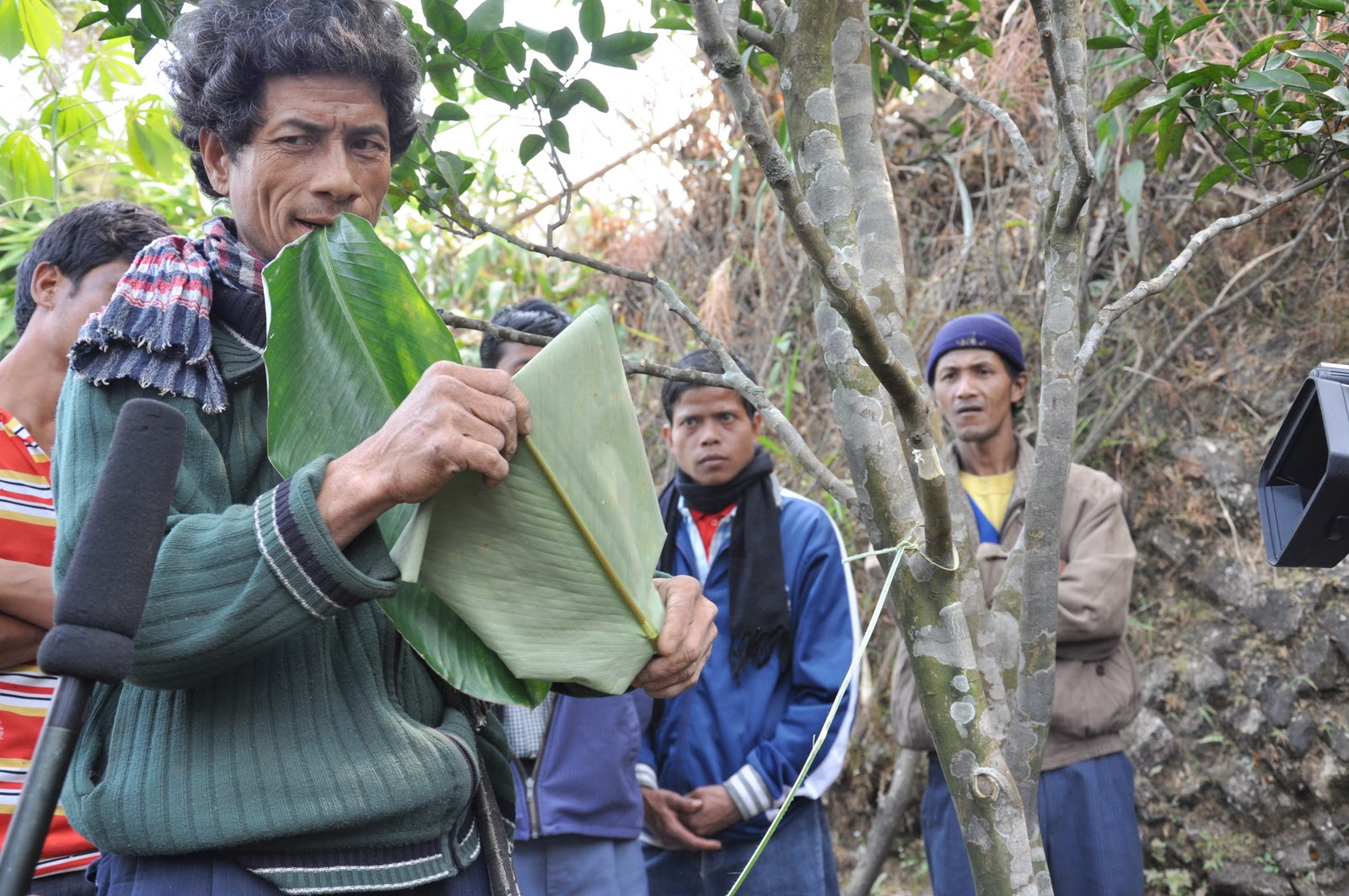
Steshon Mawiong also demonstrated to us this layering technique which he has learnt from his father. In the beginning, he dug out soils from his garden, pounded this soil with a stick and then pass it 2-3 times through a fine sieve, so that he could get very finely graded soil. He then collected this fine grained soil into a bag, and carried along “sla met” or Phrynium pubinerve leaves in lieu of plastic sheets normally used in layering. The use of ‘sla met’ leaves is his novel method used in this indigenous propagation through air layering. In order to contain the soil used in layering, he used the traditional thin bamboo strips as threads, which are used in traditional packaging methods.  A thumb sized branch is carefully selected from a mature tree, where two circular cuts are made with a knife keeping a distance of 3-4 inches from both circular cuts. The space between both these circular cuts is then scrapped of its barks with the knife. Then, the leaves are tied in the shape or a cone and then the fine soil is inserted into the cone shaped leaves. A small stick is use to push the soil firmly into the cone shaped leaves, such that the soil covers the entire part of the scrapped portion of the branch. Then, the bamboo strips are then used to tie up the entire contraption to make it air tight.

Fig. 4. Steshon Mawiong demonstrating his innovative method to the visiting team 

The best time for layering, according to Steshon is during the months of December-January. Root formation will take about 6 months (May-June) and planting can be taken up during the month of July-September. He also informed that the normal fruiting will take place by the 2nd year onwards, which is a faster way of propagation method compared to grafted, budded or seed propagated plants.
Both Steshon Mawiong and his wife, Sina Mawiong and their 2 children went about their work of harvesting the fruits of their labour and to our amazement, gifted us about 2 basket full of ripe oranges for the team – we wondered how on earth are we going to carry back this gift up the slope. To our utter surprise and relief, one of the family members also offered to carry it for us; we not only experienced hospitality at its best, but also had a firsthand experience of the generosity of this simple and hardworking family.     
(The writer is working as Agriculture Development Officer(info), Agriculture Information Wing, Directorate of Agriculture, Meghalaya and can be contacted at csshabong@gmail.com )     
 

Thursday, October 6, 2011

Agricultural Marketing in Meghalaya – Problems & Prospects

In simple words, Marketing involves finding out what the customers want and supply it to them at a profit. A classical definition is the series of services of services involved in moving a product or commodity from the point of production to the point of consumption.
Agricultural Marketing involves the movement of agricultural produce from the farm till it reaches the consumer. This covers physical handling, consolidation, transport, packing, grading, sorting, cleaning and quality control to simplify sales transaction and meet different consumer’s requirement. For the farmer, the strategic function of marketing system is to offer him a convenient outlet for his produce at remunerative price.
                                               

Why Marketing is important?
The importance of good marketing can be conveniently considered from 4 different perspective of the economy, the farmer, the product and the consumer.
As societies and States developed there is a movement of people from the rural areas into towns and cities. Urban population on an expanding average grow about 4% annually. This implies that the number of people needing to be fed by the agricultural sector will double in 16 years. In addition, since the amount of food eaten by each individual normally increase as people becomes wealthier, the supply of food to towns and cities double approximately every 10-14 years.
Therefore urban markets will inevitable become bigger. In addition to improved agricultural skills, the farmers will have to take on greater commercial skills as well. This includes understanding consumer’s preferences, delivering quality produce, market oriented production etc.

Problems and Constraints in agricultural marketing:
Farmers are unorganized and have no voice to air their grievances. They are simple and are also easily exploited. Although most of the agriculture production in our State is subsistence in nature, on the other hand, if farmers are to increase production, more attention needs to be paid to the fact that their output must be marketed at a rewarding price. Therefore commercialization of the small farm sector requires the development of market oriented production as well as development of modern marketing infrastructure and facilities to handle the movement and marketing of produce in an efficient manner.
Some of the major constraints related to the development of marketing of agricultural produce in the State can be outlined below:-

1. Lack of organization: The striking feature of agricultural marketing is the lack of any kind of collective organization among  the producers. The buyers of agricultural produce usually operate in an organized way. Under the circumstances, it is common to find that the producers of agricultural products are being exploited by the purchasers.

2. Forced sales: The farmer in general sells his produce at an unfavorable place at an unfavorable time and usually gets unfavorable terms. Because of poverty and subsistence nature of his farming, he usually disposes of his produces even at unremunerative prices. Specially when there is a glut in the market immediately after harvest,  the prices offered are generally low. The nearest place where the farmer disposes of his produce is his village. The effective price realized by the farmer is further reduced by malpractices like under weighment, unauthorized deductions etc.

3. Superfluous Middlemen: Majority of farmers dispose of their produce in the village itself. The result is the intervention of a host of middlemen between the producers and the final consumers. This in turns create a long chain of middlemen in the marketing channels which results in higher prices for the consumers, while the producer share in consumer rupee also decrease substantially. 

4. Multiplicity of market charges: The marketing charges payable by producers are numerous and varied in unregulated markets and they tend to reduce considerably the return to the producer from the sale of his produce. For instance, the farmer has to pay entry toll before his produce can be taken inside the market. Next, he has to incur carrying charges, weighing charges, commission charges etc. Further, the producer has to depend on the broker/dalal to get into contact with the commission agent/buyer. For their services he has to pay some commission. In addition to the commission, he also has to pay a number of other charges like carting /haulage, unloading the cart/basket etc.

5. Malpractices of markets: In unregulated markets, malpractices tend to be common. These are: 

·         Scales and Weights are manipulated against the seller. This practice is rendered easier by the fact that non-standardized weights are often used and due to absence of regular inspection by concerned authorities.

·         There are all kinds of arbitrary deductions and the seller has no effective means of protest against such practices.

·         Large quantities are taken away from the produce as sample and the cultivators are not paid for them even when no sale is effected.

·         Bargain between the agents who acts for the seller and the one who negotiates on behalf of the buyers are sometimes made secretly such that the seller remains ignorant of what actually takes place.

·         The broker who sells on behalf of the producer is most likely to favour the purchaser with whom he comes into contact daily.

·         When disputes arise, the producer has no means of safeguarding his interest.

6. Adulteration: Adulteration is often resorted to while marketing crops and one of the most important reason is the high amount of refraction  allowed. In most of the wholesale markets, a fixed deduction is made for impurities (say 5%) and the terms are non mutual i.e. a producer offering cleaner produce which has only 1% impurities receives the same price as the producer containing 5% impurities. Naturally when this is the case, the seller takes interest to adulterate his produce to the maximum limit.

7. Lack of information regarding prices: Absence of market intelligence as to prices is another defect that contributes to farmers being unable to take timely and effective market oriented decisions.
Good market intelligence helps farmers to
·         Reduce the risk associated with marketing
·         Check whether or not offered prices are in line with market prices
·         Decide whether or not to store
·         Decide whether to grow produce out of season
·         Decide whether or not to grow different products

8. Distress Sales: The farmer on many occasion has to resort to distress sales specially when there is a glut in the market or whenever the market prices are depressed. Since there are no storage facilities for the farmers in the market, the farmer generally has to either carry back his produce or sell even at uneconomic or throw-away prices. 

9. Inadequate Storage Facilities in the village level: The most common problem faced by farmers is the absence of adequate scientific storage facilities at the farm level. The indigenous methods of storage developed by the farmer do not adequately protect the produce from dampness, insect pest secondary infestation resulting in very high level of post harvest losses. Farmers usually store potato in heaps on the ground usually adjacent to his house. As a result, considerable heat is generated inside the heap which aids in rapid degradation of  produce quality.

Role of Regulated Market:
The State has created considerable infrastructure in the Wholesale Regulated Market in terms of market yard with associated facilities like approach roads, modern auction and grading platforms, Cold Storage, modern trader stores and rural godowns etc. The market is also managed by a market committee with adequate representation from farmers, traders including government and local bodies. This has helped in addressing the myriad problems faced by farmers with orderly marketing of farmers produce thus resulting in faster turnaround time for all the functionaries involved, thereby creating efficiency in the overall movement of produce.
Marketing of Potato in the State was brought under regulation during the year 1996. Subsequently, minor forest produce like Broomstick, Bayleaf and Resinwood were also brought under regulation. Farmer’s participation in the market has also improved which is a step in the right direction. Studies done by experts have revealed that, on an average, farmer get reasonably higher prices by selling their produce at the regulated market yard compared to rural, village and unregulated wholesale markets. Regulated Markets have helped in mitigating the market handicaps of producer sellers at the wholesale assembling level. The regulation has also helped ensure fair play of trade practices and market forces. Besides in regulated markets, market charges are clearly defined and specified. Excessive commission and other charges have been reduced and any unauthorized deductions due to quality are prohibited.
                                                               

Conclusion:
Agricultural Marketing is an adjunct to agricultural production. The production function is complete when marketing is so arranged that the producer is assured of a fair return for the investment made. Unless the farmers get remunerative prices, there is no incentive to go for increased production.
The role of the regulated market in agricultural marketing also needs further strengthening by bringing more commodities under regulation specially fruits and vegetables  and market yards equipped with better and modern infrastructural facilities  like packing units, ripening chambers, electronic scales and balances, Weight bridge, electronic display boards to display current market prices,  Linkage with national markets etc. 
 It is therefore in the fitness of things that the primary consideration for the development of agricultural marketing is to organize the existing system so as to secure for the farmer his due share in the consumer rupee, thus lifting his economic status and improving his livelihood.

(The writer is Agriculture Development Officer, Directorate of Agriculture, Meghalaya and can be contacted at csshabong@gmail.com)

Wednesday, August 3, 2011

ONLINE Soil Health Card for Farmers - An AGRISNET G2C service

                                                                By- C.S.Shabong & Ian Saiborne


Fig. 1 - A view of a Soil Testing Laboratory

            Soil is a natural medium for plant growth. In addition to anchoring the plant, soil also acts as a reservoir for plant nutrients. There are sixteen elements considered as essential for plants by scientists, viz., Carbon, Hydrogen, Oxygen, Nitrogen, Phosphorus, Potassium, Calcium, Magnesium, Sulphur, Iron, Manganese, Zinc, Boron, Copper, Molybdenum and Chlorine. These elements are considered essential because, in their absence or deficiency, the plant will not be able to flourish and complete its life cycle. All the essential plant nutrients except carbon, hydrogen and oxygen are absorbed by the plant roots from the soil.           

Soil is a complex matter made of three basic components i.e., soil solids (both mineral and organic origin), soil water and soil air. Different soils differ in their physical and chemical properties as well as the life forms flourishing in it. These components are the results of various factors ranging from climate, organisms, parent materials and age of the soil. This complex natural property of soil governs how the plant nutrients are available to plant roots. In some situations, a particular nutrient is available in plenty, where as others are locked within the different soil constituents making them unavailable to plant roots.

            The soils of Meghalaya are dominated by the laterite group. The hilly soils are mostly derived from gneissic complex parent materials and the plains adjacent to the south and northwestern plateaus have alluvial origin. The soils are fairly deep to very deep and ranging from light to medium sandy loam to clay loam in texture. They are also generally characterized by low cation exchange capacity and low base saturation percentage. Because of their location in humid areas the soils are subjected to strong leaching of cations and other elements from the surface resulting in accumulation of clay and Iron(Fe), Alluminium(Al) oxides in the sub-surface horizons, which impart red and reddish brown color to these soils. The soils are also strongly acidic to mild acidic in reaction with pH readings ranging 4.5 to 6.0.

               The soils of Meghalaya are of moderate fertility, having high organic matter content, which is an important indicator of the nitrogen supplying power of the soils. However they are generally low in available phosphorus with medium to high ratings in available potassium status. The soils favor growing of a wide variety of forest trees, plantation crops and orchards like arecanut, cashewnut, tea, pineapple, citrus, black pepper and banana etc. If external source of nutrients are supplemented in the form of fertilizers or organic manure, these soils can support a continuous cultivation of cereals and field crops viz., rice, maize, millets, pulses, potato and different types of vegetables.  

            The Department of Agriculture has established Soil Testing Laboratory in 3 districts of the State viz. Shillong, Tura and Jowai. These laboratories provide free soil testing services to the farming community where soil samples are routinely analyzed for their different physical and chemical properties including their health and fertility status. Generally soil samples are drawn from arable lands by following certain laid down procedures, before being processed and tested. The results from these different tests are then interpreted, correlated with the soil capacity to support sustained crop production, and whether external inputs like fertilizers are required to be added to the soil. Soil testing is a pre-requisite for moving towards maximizing agriculture productivity and optimizing the use of precious inputs for better margins to the cultivator or farmers. The soil testing laboratory, apart from providing free soil testing service to farmers also issue them a Soil Health Card, a two page document which provides an overview of the laboratory soil test results, as well as a crop and fertilizer dose recommendation.

Fig. 2 - Online Soil Health Card Application


            This soil health card is a document which evaluates the health or quality of a soil as a function of its characteristics, water, plant and other biological properties. The card is a tool to help the farmer to monitor and improve soil health based on their own field experience and working knowledge of their soils. Regular use will allow them to record long term trends in soil health and to assess the effects of different soil management practices. This card is most effective when filled out consistently by the same person over time. It provides a qualitative assessment of soil health. The purpose is not to compare one soil type against another, but rather to use indicators that assess each soil’s ability to support crop production within its capabilities and site limitations.
            As part of its e-governance initiatives under the Meghalaya AGRISNET project, whose vision is to provide improved services to the farming community; the Department has successfully implemented a pilot project, online soil health card in East Khasi Hills district.  Developed and customized for Meghalaya by NIC, West Bengal, the online soil health card uses web services to process all the input data as well as deliver the final e-soil health card via the internet. The application also sends an automatic SMS message to the farmer’s mobile phone at the time of registration of soil sample and when the soil health card is ready for generation at the user level. The first SMS informs the farmer about his SHC registration number while the second SMS informs that the SHC is ready for generation by the user. The online SHC is expected to provide a service level of 15 days or less as compared to more than 30 days in the earlier manual system. Further, if the farmers send properly dried soil sample, the service levels will come down even to less than 7 days. Presently, the SHC can be generated both in English and Khasi language from any Common Service Centre (CSC) or any kiosk with internet connectivity. Work on a Garo version will also be taken up shortly.


(The Writers are working as Agriculture Development Officer (info) and Scientific Officer (Soil Survey) respectively in the Directorate of Agriculture, Meghalaya)

Saturday, March 26, 2011

FLORICULTURE IN MEGHALAYA- From Vision to Fruition

                                                            - Syiem, Bary & Shabong, C.S.


Smt. Quency Thangkhiew at her Anthurium Greenhouse

          Floriculture was a passing hobby practiced by flower lovers and enthusiasts and Meghalaya is no exception. The people of Shillong were known for their passion with flowers which adorn their verandah and in lawns of prominent houses in Pine city. However in early 2000, availability of improved planting materials, seeds and other scientific, technical inputs and the increasing market demand, has encouraged growers to exploit the commercial potentialities of this hobby. As one hobbyist in Shillong remarked “this hobby of mine has now become a self paying venture due to the increasing awareness by housewives on this art”. Smt. Queency Thangkhiew, one of the earliest enthusiasts has turned this hobby into a thriving commercial enterprise. Thanks to such entrepreneurs, floriculture is now here to stay and Meghalaya is set to witness a colourful revolution in the days ahead. Thanks to the vision of the State Government to turn Meghalaya into a flower State of India, with the active support and participation of such brave entrepreneurs, the future is rosy indeed.
          Commercial floriculture is a recent phenomenon in Meghalaya, promoted and assisted by the Government of India Scheme “Technology Mission Scheme on Horticulture”. Considering the natural advantages that the State is endowed with and the varied range of agro-climatic conditions available, there is high potential for cultivation of all types of flowers. The rich flora and the many species of orchids growing wild in the State, which is the highest ever recorded in a single concentrated area, is a testimony to this fact.
          Meghalaya also has a very high potential for commercial floriculture due to the many competitive advantages the State has: a favourable climate, diverse agro climatic situations suitable for tropical and temperate flowers, competitive labour cost, proximity to Guwahati and Kolkatta Airport etc. The State is divided into 2(two) major floriculture zones namely; the temperate zone and the sub-tropical zone. The entire East and West Khasi Hills and the upper parts of Jaintia Hills district falls under temperate zone while Ri-Bhoi and the Garo Hills falls under the sub-tropical zone.

Commercial Carnations growing under Greenhouse in Nongstoin Horti Hub 
           Floriculture produce, being a non food crop, was not a thrust area in the overall agriculture development plan of the State till the late 1990’s, where the thrust was on increasing food grains production and productivity. It was in 1993-94 that the Department of Agriculture started to popularize floriculture among flower growers and enthusiast through Government of India scheme. The Agri-Horticultural Society, Shillong aided by the Department of Agriculture also organizes flower show and flower competition in Shillong to promote floriculture. This became an annual event and has brought a lot of awareness to the public about modern floriculture practices and marketing prospects.
          Further, with the establishment of a separate Directorate of Horticulture in the State, floriculture got a boost through the various schemes of the State Government like Development of Floriculture Scheme started in 2000-2001, Setting up of Model Floriculture Centre, Establishment of Floriculture projects at Dewlieh in Ri-Bhoi  and Samgong Horticulture Farm in E.Garo Hills districts through the Technology Mission Scheme on Horticulture. The objectives of the schemes were to focus on the promotional and awareness aspects by providing incentives to the farmers and motivating them to grow traditional as well as non-traditional floral crops and houseplants for commercial purpose. The nature of assistance provided is in the form of providing the growers with diseased free planting material, organic/inorganic fertilizers, plant protection chemicals, garden tools and implements for a minimum area of 2000 square meters, along with a package of practices for commercial production. Each unit is envisaged to serve as a demonstration model for which the Department provides technical guidelines through extension and training. Crop selection is on the basis of existing popularity and market demands. A few of the recommended ornamental crops grown are Orchids, Chrysanthemums, Gerberras, Carnations, Liliums, Strelitzia reginae, Gladiolus, Asters, Marigolds, Statice, Gomphrenas, Helichyrsums, Zinnias, Roses and different kind of house plants etc. The concerted effort of the Department in motivating growers as well as providing infrastructural support in the form of green house, poly house, shade nets and other inputs has led to the establishment of a number of private nurseries especially in the East Khasi Hills district.
          The Directorate of Horticulture has also identified floriculture clusters in the State which are suitable for growing certain high value flowers. East Khasi Hills have been identified for Orchids, Carnations and Gerbera; West Khasi Hills for Carnations; Jaintia Hills for Bird of Paradise; Ri-Bhoi for Orchid, Rose, Anthurium, Lilium and Foliage; West Garo Hills for Liliums and Bird of Paradise; East Garo Hills for Anthurium, Foliage and Bird of Paradise. At present, East Khasi Hills, East Garo Hills and Ri-Bhoi districts have established green house floriculture units in the departmental farms as well as in farmer’s field. The estimated area under floriculture in the State is about 500 Hectares.
          The Rose Pilot project which was initially started at Dewlieh Departmental Farm in Ri-Bhoi district at an area of 0.5 hectare has been a success with a production of 2500 cut flowers per day. Today, Rose, Lilium and Anthurium cultivation has also been extended to farmer’s field in village clusters through self help groups and individual farmers. 
          The Anthurium project at Samgong Horticulture farm is a tourist spot for farmers, high power dignitaries and the common people. This is because of the success of the project taken under the cultivation of the flower. The excellent marketing of anthurium as cut flower gives a phenomenal impact to the farmers which encouraged them to go for commercial group cultivation.
            Commercially, there are several existing limitations in the floriculture development in the State, which needs to be overcome through proper planning and developmental efforts at all levels. However, from a technical point of view, the development of floriculture business enterprises in Meghalaya has a very high potential. This potential can be exploited to improve the socio-economic condition of the State. In addition, being a major export item, it can substantially contribute towards foreign exchange earning of the entire country.
          The India Today ranking of States in India has shown Meghalaya’s agriculture to be faring comparatively better among the Small States in North Eastern Region and the magazine ranked Meghalaya comparatively better. The State has also improved from its earlier overall 5th position during 2006 to becoming 1st among North Eastern States (except Assam which is categorized as a big State) during 2007.  This goes on to show that agriculture, specially horticulture in Meghalaya is on a growth trajectory and the State only needs a boost in resources, better post harvest management, marketing linkages, organized marketing and creation of economy of scale in order to accelerate it to the take off stage. With the right policies of the State Government and adequate fund injection through the Technology Mission for Horticulture Development along with farmer’s and entrepreneurs of the State coming forward to take up commercial floriculture, Meghalaya will not be lagging behind and the vision articulated by the Department of Agriculture will hopefully, flower and bloom in its full glory and beauty.  

(The writers are Agriculture Information Officer and Agriculture Development Officer, respectively working in the Department of Agriculture, Meghalaya)

Friday, March 25, 2011

Meghalaya, the land of wine and honey

                                                                     -By Bary Syiem *
Meghalaya, the land of hynñiew trep and hynñiew skhum is blessed with a variety of agro-climatic conditions favoring cultivation of different types of horticultural crops like fruits, vegetables, flowers etc. The natural vegetation profile ranges from tropical to temperate type and indeed, Meghalaya can appropriately be classed as a Horticulture state.

Sohiong wine being promoted in the Indigenous Plant Festival during 2010
 Under this climatic variation, the state harbors an enormous diversity of plants both domesticated and wild, with an impressive variety of habitats and an ecosystem which is a treasure house where future economy can be sustained.  
          Meghalaya is also the home of many indigenous species of fruit plants which may not be found anywhere else in the world. The horticultural wealth of the state in terms of fruit plants includes Peach, Plum, Pear, Pineapple, Banana, Sohphie, Sohiong, Sohshang, Sohphoh Khasi, Sohlang, Sohbrap etc.
The credibility of Horticulture in this state has indeed been established beyond doubt in improving productivity of land, generating employment and also improving the economic conditions of the farmers and entrepreneurs of the state. But the true potential of horticulture can be reached only through effective diversification of its horticultural strength in terms of value addition to horticultural products, capitalizing on market monopoly of our indigenous fruits and their products, popularization and commercialization of indigenous fruits, plants, indigenous herbs and medicinal plants etc. Constraints in the horticulture sector no doubt exist in terms of marketing facilities, lack of infrastructure, poor management system, inadequate institutional mechanism to support horticulture development as per changing trends etc. Some of these constraints are being addressed by the Directorate of Horticulture through various new schemes and their extension machineries, and as a result, the farmers are able to take up cultivation of horticultural crops on a larger scale thereby enabling them to improve on the production of horticultural commodities.
Despite these achievements, there exists a wide gap between the potential and the actual realization. With increasing population and requirements, diversification of horticultural products has to take place. This will encourage the farmers and will act as an incentive to increase production of various fruits.
          As we know, horticulture produce  are highly perishable in nature but over the years, the people of Meghalaya have found many uses for the many varieties of fruits growing here besides enjoying them for table purposes. These include making jams, jellies, squash, and juices to name a few. Looking towards the future people can now exploit the age old hobby of wine making. This trend which certain NGO,s are encouraging through the Wine Festivals etc, takes full advantage of the rich fruit resources of our state.  Some of the home-made wines that were showcased last year included; Sohiong wine, Sohbrap (passion fruit) wine, Sohlang wine, Plum wine, Pineapple wine, Pear wine and a variety of enticing combinations such as Sohmon with Sohiong wine. This hobby could grow gradually as a cottage industry and then commercialized into an industry, which would automatically boost the economy of the state. 
If fruit production, especially our indigenous fruits, is encouraged, this will provide wine makers with a larger selection. And as wine making gains popularity, fruit farmers will have a better market for their harvest. For instance, when the fruit market is saturated during a particularly good season, many farmers lose much of their profit and product due to inability to sell before the fruit is over ripe.  However, if wine makers become viable customers, the farmer would have a market for his fruit.
          It is sincerely hoped that Shillong wine festival and other indigenous fruit festival will help create awareness not only on the art of wine making but also its commercial potential as an industry which will in turn encourage the farming community to grow more fruit trees and thereby realize the full horticulture potential of our state with an economy to match.

(The writer is Agriculture Information Officer, Directorate of Agriculture, Meghalaya and can be contacted at barysyiem@gmail.com)

Friday, March 11, 2011

Horticulture in Meghalaya - A New Development Paradigm

                                                                                                        - Canning S Shabong *
Meghalaya offers an excellent scope for growing of different types of horticultural crops including Fruits, Vegetables, Spices, Plantation crops, Medicinal and Aromatic plants of high economic value. A wide range of tropical, sub- tropical and temperate fruits such as Mandarin Orange, Pineapple, Banana, Lemon, Guava, Pear, Plum etc. are grown all over the State. A large variety of fruits & vegetables, both indigenous and exotic are grown across a wide range of agro climatic zones. The higher altitudes provides conducive ecosystem to grow traditional vegetables like Potato and Cole crops during the rainy season. Tuber and Root crops such as Sweet Potato and Tapioca, Spices such as Turmeric, Ginger, Chillies, etc. also grow abundantly. Plantation crops such as Tea, Cashewnut, Coconut, Arecanut and other spice crop like Black Pepper have been performing well and offer good scope for area expansion. In the long run, these crops can change the entire economic situation of the people of the State.
th Five Year Plan period. Setting up of Cold Chains, Refer Vans are in the pipeline and these will complement the expected surge in production volumes of high value crops in the medium term.
A paradigm shift in approach, priority and focus has been the hallmark of this initiative, which functions on a "farmer’s first" principle. Recognising that Horticulture Development cannot take place in isolation, the Department will strive towards a total approach
from the farm gate, right up the value chain till it reaches the consumer’s plate.
Further, 5 Farmer’s market and 4 new horti hubs will be established along with cold chain and transportation facilities. These initiatives will further provide a boost to the sector.

Photo : Strawberry Plantation in East Khasi Hills District 
This paradigm shift initiated by the department has the potential to propel horticulture as one of the lead sectors in the State. These new initiatives will not suffice if farmers, entrepreneurs and private sector do not actively participate in this vision. The existing gap between the departmental officials and the farmers needs to be bridged, while closer interaction and partnership is the order of the day. The Directorate has also taken the lead in equipping the farmers and entrepreneurs with the best technology and marketing skills through the expertise of the Horticulture Training Centre, Pune, which is a premier training agency in the field of high tech horticulture.
The total cropped area in the State during 2008-09 was 3.37 lakh hectares which is 15.03% of the total geographical area of 22.42 lakh Ha. The net cropped was 2.84 lakh hectares, which is 12.66% of the geographical area. The total area under fruit crops during 2008-09 was 27.02 thousand hectares. Among the fruit crops, the maximum area is under Pineapple (10.53 thousand ha) followed by Citrus (9.36 thousand ha) and banana (6.52 thousand ha). The total area under vegetable crops was 11.94 thousand hectares. As far as spices are concerned, Meghalaya is one of the leading States in Ginger production (area of 9.28 thousand Ha. with production of 50.28 thousand MT) and also one of the leading producers of quality Turmeric (area of 1.9 thousand Ha. and production of 10.04 thousand MT) of a variety known as Lakadong, which has about 7% curcumin content. Arecanut and Cashewnut are leading plantation crops followed by Tea. The total area under plantation crops is 26.86 thousand hectares.
The State’s foray into high value low volume crops, of which Strawberry is the prominent and successful introduction, has changed the economic landscape of the strawberry growers of Ri-Bhoi district. Other crops like like Rose, Liliums, Anthuriums, Carnations, Birds of paradise are also performing extremely well. High value vegetables like Brocoli and colored Capsicum have been introduced and marketed successfully.
Today, the State has successfully set up Horticulture Hubs in all the seven (7) districts of the State with specialisation in flowers and high value vegetables. Each horti hubs will in turn be served by spokes comprising collection centres and crop clusters of surrounding villages within a radius of 10 Km.
The State is organic by tradition and the Directorate has taken steps to introduce organic certification on select horticultural crops. Initially, the organic products can cater to the existing demand in the metro cities, gradually building scale to tap the export markets in the immediate future. The process of organic certification for Tea, Pineapple, Cashewnut, Ginger, Turmeric and Vegetables have been intiated. Organic manures like vermicompost and bio-fertilizers like Rhizobium and Azolla are also being promoted in farmer’s field.
Use of Green house technology, poly-houses, drip and micro irrigation system, water harvesting structures, fertigation, soilless culture are being popularised in order to minimise risk and help farmers overcome the vagaries of nature as well as to standardise quality of produce and reduce economic losses.
Post harvest management, value addition, processing and marketing are the other priority areas that the Department is giving renewed thrust during the 11 Five Year plan period.

( The writer is working as Agriculture Development Officer in the Directorate of Agriculture, Meghalaya and can be contacted at csshabong@gmail.com)